Excuse the presumptuous title, if you will: all of the following reflects only the opinion of the writer.
In our popular culture, there are certain stereotypes of the kind of person that aligns himself with a political party. I know the stereotypical democrat fairly well, because I am one. Our cultural picture of a democrat is an over-optimistic, second generation hippie who get offended by politically incorrect language and listen to NPR.
All right, culture. Fair enough.
This image spans all demographics of liberals--it's as easy to picture me, a student at a progressive college, fitting this type, as it is to picture an old thin white man believing it.
I don't know why Democrats are always depicted as thinner, but it's a prevalent enough stereotype that in second grade (during the controversial 2001 election), my main discerning factor between a Democrat and a Republican was weight. Maybe it's the donkey/elephant thing.


And that, my friends, is where the trouble lies—that
is why our checks and balances and fighting for our self interest is not making
the population happy. These people, these millions of voters, are not fighting
for their own self interest at all. They are fighting for the self interest of
a vague religious figure, the self interest of unborn babies, and the self
interest of the founding fathers who, apparently, were all evangelical Christians.
In our popular culture, there are certain stereotypes of the kind of person that aligns himself with a political party. I know the stereotypical democrat fairly well, because I am one. Our cultural picture of a democrat is an over-optimistic, second generation hippie who get offended by politically incorrect language and listen to NPR.
All right, culture. Fair enough.
This image spans all demographics of liberals--it's as easy to picture me, a student at a progressive college, fitting this type, as it is to picture an old thin white man believing it.
I don't know why Democrats are always depicted as thinner, but it's a prevalent enough stereotype that in second grade (during the controversial 2001 election), my main discerning factor between a Democrat and a Republican was weight. Maybe it's the donkey/elephant thing.
 |
| Another Democrat stereotype: |
 |
| Goes to Bennington? |
The stereotypes of Republicans, however, are fairly disparate: There's the upper class, Regan worshipping white man, and the very lower class, over-patriotic redneck.


Another Democrat stereotype--liberals watch too much 30 Rock?
Moving on!
This is a strange cultural break that makes judging people more difficult--but that is not the only problem with this situation.
It doesn't take a political analyst to realize that the country is in the midst of a rather severe battle between the political parties. In many ways, this is a problem--there are many cases in which it has prevented progress from being made or change from happening, it stops compromise in its tracks, and it causes people on both ends of the spectrum to be close-minded about pressing issues. For instance: many people's criticism of President Obama is that he hasn't done anything, but it's quite clear that anything he's tried to do, whether it's considered helpful or detrimental, has been stopped in its tracks by the Republican majority in the legislature.
There is another side to this problem: having the legislature stop the President in his tracks sounds a lot like our holy system of checks and balances at work. If the majority of people voted for these conservative senators and representatives, then it means that the majority of people share their beliefs and agree with the policies they want to make. This is what our government was designed for! The Constitution is based around the idea of everybody fighting for their own self-interest.
In a country which spans such a variety of geographical locations, it is necessary to anticipate differences of opinion even on the most basic level. Policy about agriculture and trade for coastal communities is made under a completely different set of requirements than in places more inland, which are still different than those northern geographies. With more advanced thinking comes class differences, religious differences, and sociopolitical beliefs, and with all of that comes more diverseness in needs and ideas about how the country should be run. The founding fathers were entirely aware of this when they designed our government, and the structure shows this. Checks and balances, the trial process that laws often face in the Supreme court, and the bipartisan nature of our elections, which dates back to the ratification of the Constitution, are all evidence of this.
What's the problem, then? Theoretically, our government should thrive on different demographics battling they way they are right now. We are winding the watch to make the governmental gears grind. And who am I, a stereotypically leftist liberal arts student, to say that the bipartisan culture we currently have isn't working?
It's fairly clear that people are unhappy. The Tea Party movement and, what I may riskily venture to call it's liberal counterpart, the Occupy movement, were characterized as aimless and angry, ineffective uprisings of socially heterogeneous folks, and ultimately, they accomplished very little in the way of policy changes or economic progress. The main goal seems to have been a large-scale expression of displeasure with the "system" as it is, but people can't quite say what the problem is. There are the watch gears, (our government, if you aren't following my insane metaphor,) and we are turning the knob and the parts are moving, but for some reason the big hand is still pointing to the six and we're so sure that it's seven o'clock.
Perhaps the grain of sand wedged between the gears is the disparity between the demographics of the Republican party. This is a concept that was discussed in the past, mostly in reference to Hillary Clinton. I can't find any recent articles about it, but it seems like something that is entirely relevant right now.
One of the main reasons I question the reasoning behind the existence of lower-class Republicans is because of the Bush tax cuts. It seems reasonable to assume that people who make less money would want, first and foremost, to be saving money, and it seems reasonable to assume that they would come to resent those who make more money.
It’s fairly clear that
is what the Occupy movement was expressing--a frustration with the lavish
lifestyles of the wealthy and the clear gap between them and “the rest of us,”
as it were—the 99%. It seems, however, that the protests were largely considered
to be a liberal movement. The Tea Party movement called for an overhaul in the
government, and supports candidates who support the continuation of the Bush
tax cuts.
A lot of this can
be explained by the existence of Values Voters—people who
align themselves with socially conservative candidates who, incidentally, also
support lower taxes on the rich. “Values voters” can be used as either a
general term to refer to the religious demographic in the middle and southern
parts of the country, or to refer to the specific group who call themselves the
Values Voters, which is a subset of the Family Research Council.
Far from seeing
voting for candidates based only on religious values as short sighted, close
minded, or problematic in any way, this group believes that all of our
country’s ills come from the lack of morality and overabundance of sinning that
we are suffering from. “Many issues are at stake,” their video states, in white
letters overlaid on pictures of rising gas prices, oil drilling, and Wall
Street, “but none are more important than faith. family. marriage. life.”
Yes, those are
periods. Grammar is not one of the important issues here, friends.
The video contains
a lot of interesting implications, including the fact that our forefathers
(who, apparently, wore cowboy hats and were caught on video fighting for our
country,) based the nation on “Judeo-Christian values” and subsequently fought
to preserve them.
That isn’t
true—separation of church and state is built into the Constitution, and if you
really want to get back to our founding ideals, freedom of religion is why
Puritans (who were sort of the Evangelical Christians of the day, to be fair,)
came to the country in the first place. Perhaps, however, it is better to have
that discussion another day. More relevant, another implication in the video is
that the power to vote is inherent to Evangelical Christianity, and that the 60 million alleged evangelical voters
have a duty to THE MAN JESUS CHRIST, as he is referred to by the advertisement,
to vote based on their values and not on other political or economic issues. They
need to vote for the voices of millions of “unheard innocents,” which is how
they delicately refer to unborn fetuses. The issue here is not the separation
of church from state, but the separation of state from church.
Oddly enough,
Christians are represented in the video by a stock photo of an old man in
overalls holding his hand out to a young boy, also in overalls. Clearly, they
are meant to be rural farmers—and we can go ahead and infer that those rural
farmers are not part of the 1%. Even these stock photo evangelicals are not
benefitting from the policies of the people they are voting for.
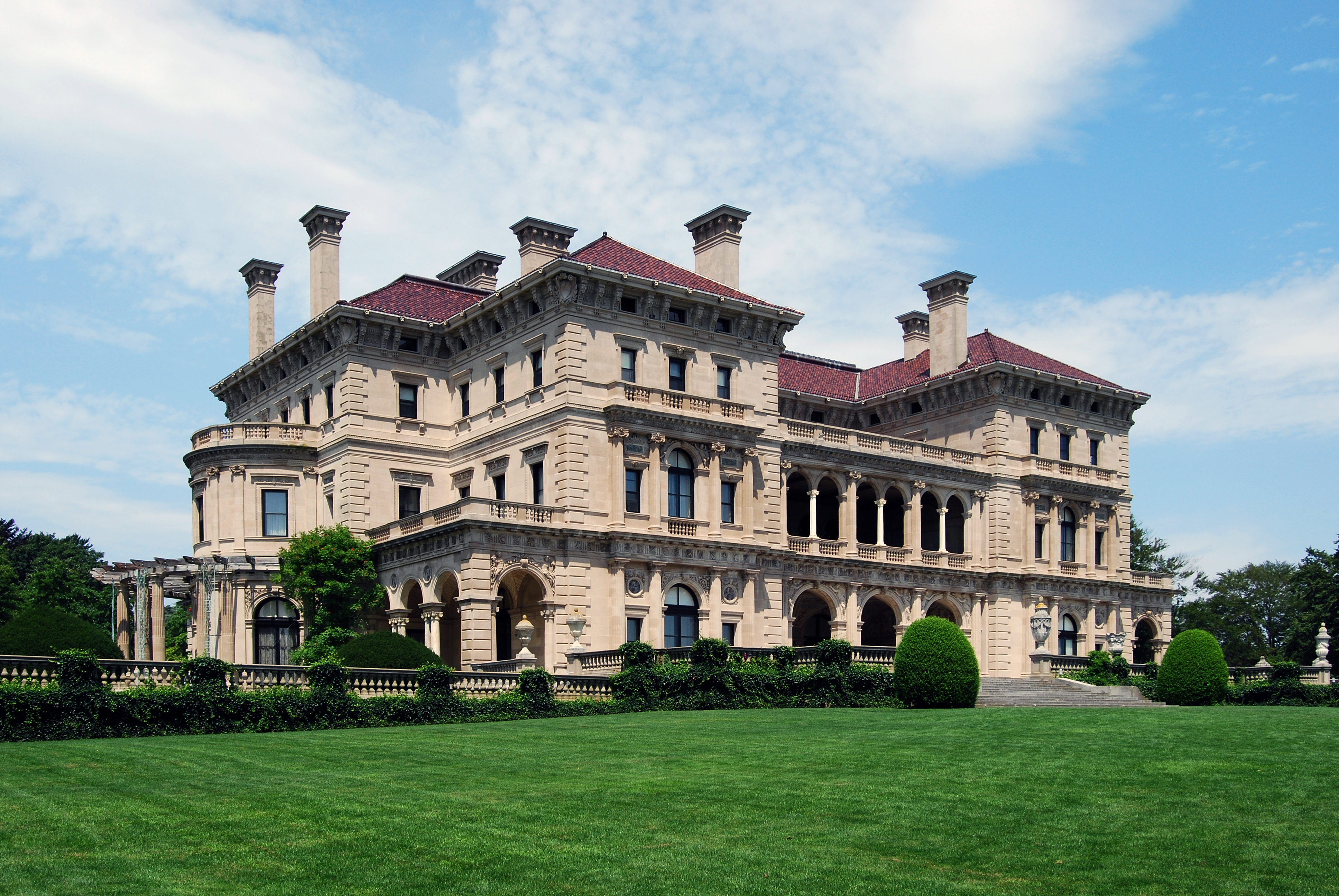
This situation has an interesting historical counterpart in the Gilded Age. This period is represented by a super rich upper class who lived in super crazy mansions, as well as an extremely poor lower class who lived in extremely overcrowded and upsetting tenements, while working for the industries and companies owned by the super rich. During this time, it wasn't Christian values that caused people to allow this to happen, but it was a belief system that justified it--a little something I (and everyone else) like to call Social Darwinism . The idea is that the fittest survive in the world of capitalism--successful people rose to industrial power because they were the most talented and worked the hardest. That's called "the myth of the self made man," and it's still around today. One might argue that it is as relevant to people who do not benefit from the current tax structure as Evangelical values are.
The irony here is quite beautiful--Social Darwinism, something inherently sacrilegious as it deals with contradicting creationism, is working along side Evangelical Christianity to perpetuate something that is ultimately not beneficial to most of the country, (in my opinion).
And Evangelicals in particular are not exactly benefiting from the tax cuts that are, mainly, for the rich: a series of graphs about the Evangelical Protestant tradition from The Pew Forum shows that 58% of Evangelicals make less than $50,000 dollars a year, and, we can assume, are voting with their values.